


On 9 May 2023, the Department of Health and Aged Care held a webinar titled: A new model for regulating aged care which was facilitated by Caroline Turnour, Assistant Secretary – Harmonisation and Regulatory Strategy Branch and Mel Metz, Assistant Secretary – Legislative Reform Branch.
The webinar forms part of the consultation process in regards to A new model for regulating aged care – Consultation paper 2 – Details of the proposed new model which covers:
- Raising the quality of aged care
- Supporting quality care
- Becoming a provider
- Responsibilities of a provider
- Holding providers accountable and
- Transitioning to the new model.
The new model has been designed to support the facilitation of cultural change across the sector and is founded on placing older people at the centre of regulation, increasing protections while also empowering older people to exercise their rights within the reformed aged care system. These rights will be outlined in a Statement of Rights, which will be included in the new Aged Care Act. A copy of the Statement of Rights is yet to be publicly released.
Underpinning the new regulatory model for aged care are four foundations, which support an approach that is:
- Rights-based
- Person-centred
- Risk proportionate and
- Focused on continuous improvement.
These foundations aim to increase the protection of older people and support them to exercise their rights, while also driving cultural change within the sector to instil new values and behaviours. The new model will also focus on improving provider capability and sustainability, while simultaneously improving public confidence and supporting continuous improvement across the sector.
The Proposed Methodology
A new approach to supporting quality care
The new model is designed to support and incentivise the aged care sector to strengthen their approach towards continuous improvement, drive cultural change, improve working relationships, form deeper trust, and allow greater transparency to enable the sector to strive for excellence.
This will be achieved though regulator safeguards, functions & tools.
A new approach to becoming a provider
There will be a universal provider registration & re-registration requirement, which includes six categories:
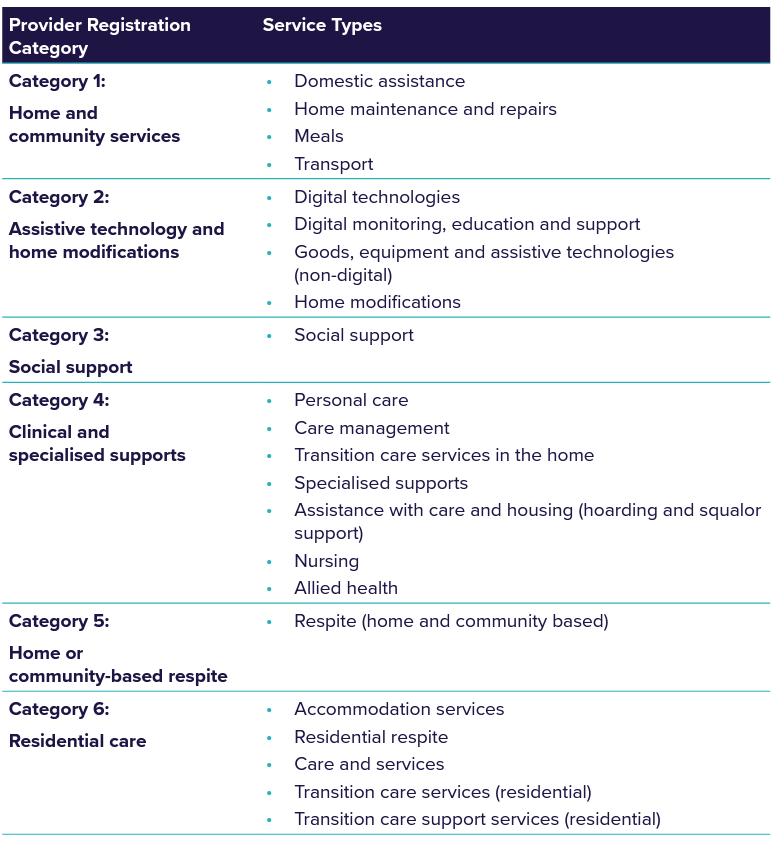
Assessment of provider suitability will occur at the time of registration & re-registration. It is proposed that the standard registration period will be 3 years and that Categories 4-6 will undergo quality assessments based on the strengthened Quality Standards.
A new approach to provider obligations and responsibilities
These new obligations have been developed to ensure providers have a clear understanding of the expected standard of care they must deliver and the consequences, if they fail to deliver on this standard of care to older people.
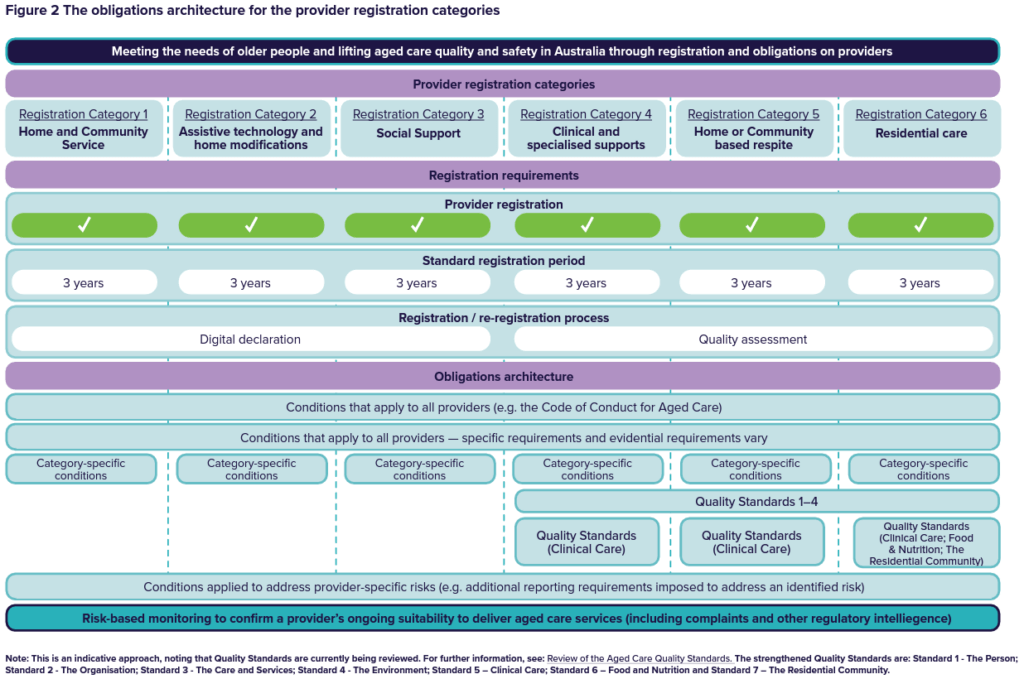
These have been broadly grouped into the following categories:
- Overarching obligations
- Core conditions of registration
- Category-specific conditions of registration and
- Provider-specific conditions of registration.
Below is a visual representation of the architecture for provider obligations.
A new approach to holding providers accountable
It is expected that the regulators monitoring, investigation, and enforcement powers will be broadened, streamlined, and strengthened to allow for increased flexibility enabling the regulator to address risks proactively, which will support the sector to improve quality care outcomes. In addition, risk-based monitoring will be undertaken using new data intelligence.
A transition approach for existing providers and changes for new providers entering aged care
The transition to the new regulatory model is expected to have a single ‘go-live’ date, which will begin when the new Act commences; at this time the current regulatory framework will cease. In order to stagger provider registration under the new regulatory model, existing Commonwealth funded aged care providers will be deemed into registration categories under their existing entity name/structure. Providers will be issued a certificate of registration with no additional registration payments required until re-registration.